


5 Above Ground Pool Safety Fence Ideas For Your Backyard
Summer pool season runs June through August for most families in Southern New Hampshire, and those months go fast. If you have an above ground pool and young children in or around your property, an above ground pool safety fence is not a nice-to-have. It is a legal requirement in New Hampshire and, more importantly, a genuine life-safety barrier between your kids and unsupervised water access. If you want to understand your options before committing, our team can walk you through materials, configurations, and what code compliance looks like for your specific property, taking your needs into account and providing attentive customer support every step of the way. Our reputation in the fencing world is built on trusted service and expertise. Here is what you need to know.
Here is what you will find in this guide:
- Why pool fencing is legally required and what the stakes are
- The fence material options that work best for above ground pools
- New Hampshire-specific code requirements you need to follow
- Gate hardware details that make or break a compliant installation
- What to expect from pricing and how to plan your project
- Ongoing support from our team to help you through every stage

The Stakes Are Real: Why Pool Fencing Cannot Wait
Drowning is the leading cause of unintentional death among children ages 1 to 4 in the United States, according to the American Red Cross. The numbers behind that statistic are sobering. The U.S. Consumer Product Safety Commission reports that between 2019 and 2021, an average of 358 children fatally drowned in pools or spas each year, and 75 percent of those victims were younger than 5 years old. Perhaps the most important detail: 81 percent of fatal child drownings occurred in residential settings.
Young children move fast and quietly. As many as 69 percent of young children found submerged in swimming pools were not expected to be near the water at all, according to the American Red Cross. A fence does not replace supervision, but it creates a critical barrier that buys time. For families in Amherst, NH and surrounding areas with pools on larger lots, where children can move freely between the yard and the pool area, a properly installed pool fence is one of the most important safety features on your property. Above ground pool fences are designed to enhance security by preventing unauthorized access, significantly reducing the risk of accidental drownings for children and pets.
Here is why getting this right matters beyond just meeting code:
- Child safety first: A fence with a properly latched, self-closing gate is the most effective physical barrier between unsupervised children and pool water. Proper fencing can decrease the risk of drowning by nearly 85%.
- Legal compliance: New Hampshire requires pool barriers that meet the International Swimming Pool and Spa Code. Non-compliance can result in fines and liability exposure.
- Insurance protection: Many homeowners insurance policies require compliant pool barriers. A non-compliant installation can create coverage gaps.
- Peace of mind for guests, children, and pets: Neighborhood kids, visiting grandchildren, and pets create pool access risks beyond your own family. A secure fence addresses all of it and enhances security for everyone.
- Property value: A properly installed, attractive pool fence adds value rather than detracting from the look of your backyard.
5 Above Ground Pool Safety Fence Ideas Worth Considering
The right fence for your above ground pool depends on your budget, your yard, your aesthetic preferences, and how seriously you want to address containment. Most above ground pool safety fences are designed to fit standard pool sizes, and adjustments can be made by trimming the railing if necessary. Many above ground pool safety fences are lightweight and maintenance free, made from UV-protected rigid vinyl for durability and ease of installation. Here is a breakdown of the most practical options for Southern NH homeowners.
1. Ornamental Aluminum Fencing
Aluminum is one of the most popular choices for pool safety fencing because it checks every box: it is durable, attractive, code-compliant, and requires virtually no maintenance. Black powder-coated aluminum has become the go-to choice for homeowners in Amherst, NH and surrounding areas who want a fence that enhances the look of their backyard while meeting every safety requirement.
Aluminum fencing for pool applications is typically installed at 54 inches tall to meet the gate latch height requirement under New Hampshire pool barrier rules. The picket spacing on aluminum fence panels can be configured to meet the code requirement that no opening allow passage of a 4-inch-diameter sphere. Horizontal rails are positioned on the pool side of the fence to prevent climbing footholds on the exterior.
Why aluminum works well for pool safety:
- Rust-proof, even with constant splash and pool chemical exposure
- Powder-coated finish holds up through New Hampshire winters without peeling or fading
- Looks sharp alongside both contemporary and traditional home exteriors
- Available in a range of heights and picket styles to satisfy both code and design goals
2. Chain Link Fencing
Chain link is a cost-effective, compliant option for above ground pool barriers, particularly on larger properties where budget efficiency matters. However, not just any chain link will do for pool applications. New Hampshire has a stricter mesh size requirement than the International Building Code baseline. While the IBC allows up to a 2.25-inch square mesh for pool fencing, New Hampshire requires a maximum mesh size of 1.25 inches to reduce the ability of small children to use the mesh as a climbing surface.
Black vinyl-coated chain link is the most common choice for residential pool applications in Amherst, NH and surrounding areas because it looks better than bare galvanized and provides an additional layer of corrosion protection from pool splash and humidity. For pet owners who also need yard containment, chain link handles both jobs well.
Key specs to know for chain link pool fencing:
- Mesh size must not exceed 1.25 inches square under New Hampshire pool barrier rules
- Fence height must be at least 48 inches measured on the exterior
- Gate hardware must be self-closing and self-latching with the latch positioned at least 54 inches above ground level

3. Decorative Vinyl Fencing
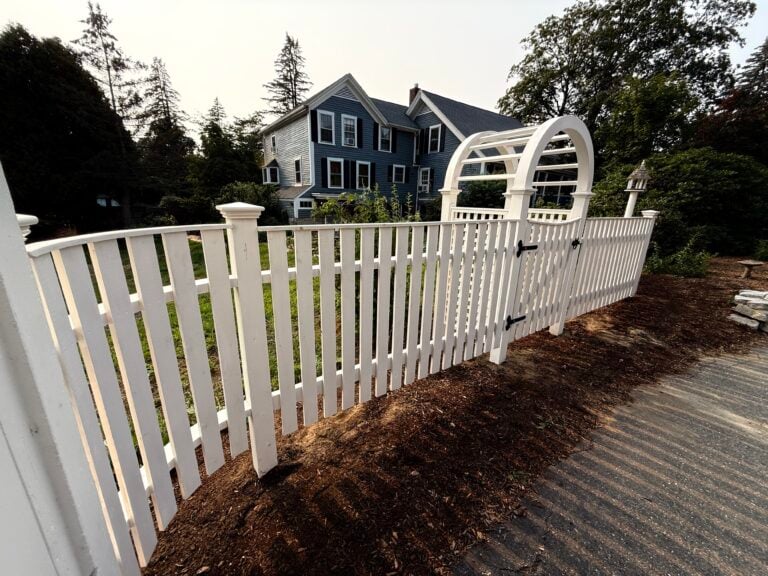
For homeowners who want the look of a finished outdoor living space rather than a utilitarian barrier, vinyl privacy or semi-privacy fencing can work well around an above ground pool. Vinyl holds up exceptionally well against moisture and pool chemicals, never rots, and requires nothing more than an occasional rinse to stay looking clean. White and tan are the most common color choices, and both complement the aesthetic of most New England homes.
The trade-off with solid vinyl is visibility. A privacy fence eliminates sight lines into the pool area from outside the fence, which means you cannot monitor the pool without being inside the enclosure. For families who want to be able to see the pool from the deck or kitchen window, a semi-privacy or picket-style vinyl option maintains better sightlines while still meeting height and spacing requirements.
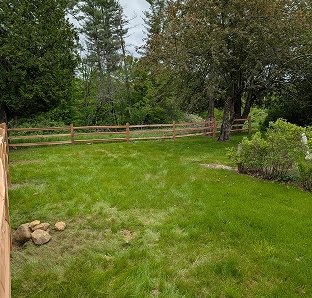
4. Decorative Cedar Fencing
Cedar brings a natural warmth to a backyard pool setting that aluminum and vinyl cannot fully replicate. For homeowners in Amherst, NH and surrounding areas who want a fence that feels like a natural part of a landscaped outdoor space, cedar is a compelling option. It accepts stain and paint well, allows for custom designs, and has a character that manufactured materials do not match.
The practical consideration with cedar around a pool is maintenance. Wood exposed to constant water, splash, and humidity needs regular staining or sealing to stay in good condition and resist rot. For a homeowner who is happy to put in that effort every few years, cedar is a beautiful choice. For one who wants to minimize upkeep, aluminum or vinyl will serve better in the long run.
5. Combination Approaches
Some of the most attractive pool fence installations in Southern NH combine materials strategically. A common approach is using decorative aluminum or vinyl fencing along the most visible sides of the pool area, then running chain link along the wooded or less-visible perimeter sections. This keeps the overall look polished from the yard and house while managing budget on the sections nobody really looks at.
Another approach is using the pool structure itself as part of the barrier on the pool side and fencing only the surrounding yard area, combined with a lockable or removable ladder that prevents unsupported access to the pool deck. This approach has specific code requirements and should be reviewed with a professional before assuming it satisfies local regulations in your municipality.
New Hampshire Pool Fence Code: What You Need to Know
New Hampshire’s pool barrier requirements are based on the International Swimming Pool and Spa Code with several state-specific amendments. These rules apply to both in-ground and above-ground pools, and non-compliance can result in fines ranging from $100 to $1,000 per violation from local building departments.
A typical above ground pool fence kit includes all necessary fence sections, fence posts, mounting brackets, installation instructions, and required hardware for straightforward setup. The base kit is designed to cover a set number of pool uprights, and additional kits can be added to fully enclose larger pools. Each fence section fits between two pool uprights, so the total number of sections needed depends on your pool’s structure. Most ground pool fence kits are modular for easy customization, and the Premium Guard Pool Fence is a modular system made of UV-protected, rustproof PVC resin that can be ordered by the section.
Here are the key requirements every NH pool owner needs to understand:
- Minimum fence height: The barrier must be at least 48 inches tall measured on the exterior side facing away from the pool
- Ground clearance: The bottom of the fence must be no more than 2 inches above the ground on the exterior side. If the barrier is mounted on top of the pool structure, the maximum clearance between the pool structure and the bottom of the fence is 4 inches. The fence should completely enclose the pool, with no gaps greater than 2 inches at the bottom.
- Opening size: No opening in the fence should allow passage of a 4-inch-diameter sphere. Narrow picket spacing (less than 4 inches) is required to prevent child access.
- Chain link mesh: New Hampshire’s maximum mesh size of 1.25 inches is stricter than the national standard
- Horizontal members: If horizontal rails are present on the exterior face of the fence and are spaced less than 45 inches apart, vertical picket spacing must not exceed 1.75 inches
- Gate latch height: Gates must be self-closing and self-latching, with the latch positioned at least 54 inches above ground level. This is one area where New Hampshire is stricter than the IBC baseline
- Climbability: The fence must be positioned so that no permanent structures, equipment, or objects near it can be used to climb over it
- Key safety features: Look for non-climbable materials, self-closing/self-latching gates, and modular kits that include all required hardware, posts, fence sections, mounting brackets, and clear installation instructions for secure assembly.
Most municipalities in New Hampshire require a permit before installing a pool barrier. It is worth calling your local building department before installation begins to confirm what documentation they need and whether a pre-installation inspection is required.

Gate Hardware: The Detail That Makes or Breaks Compliance
A fence is only as secure as its gate, and pool gate hardware is an area where corners get cut far too often. Crowe Fence & Deck uses D&D Technologies hardware on pool gates, specifically the Magna-Latch series, which is purpose-built for pool safety applications and has extensive product documentation and testing data to back it up.
Here is what compliant pool gate hardware looks like in practice:
Self-Closing Hinges
The gate must return to a fully closed and latched position on its own every single time it is opened. Spring-loaded or hydraulic self-closing hinges accomplish this. A gate that swings and stays open, even briefly, creates a window for a toddler to slip through undetected.
Self-Latching Mechanism
The latch must engage automatically when the gate closes, without requiring any action from the person passing through. The Magna-Latch and similar devices from D&D Technologies are magnetic and engage reliably without the deterioration issues that spring-based latches can develop over time.
Latch Height
New Hampshire requires the release mechanism to be positioned at least 54 inches above the ground. This height is specifically calibrated to keep young children from being able to reach and operate the latch from outside the fence. If the latch is on the pool side of the gate, it can be positioned lower, but it must then be paired with a barrier that prevents small hands from reaching through to trip it from the outside.
Gate Opening Direction
Gates in pool enclosures should open outward, away from the pool. This ensures that a child pressing against the gate from the pool side cannot inadvertently push it open.
Pricing: What Does a Pool Safety Fence Cost?
Pool safety fence pricing in Southern New Hampshire varies based on material, linear footage, height, and the complexity of the gate configuration. Many above ground pool safety fence kits can be easily added to your cart online for convenient purchasing. Before making a decision, be sure to check recent customer reviews to ensure product quality and satisfaction. We are building out specific pricing for each material option and will update this section shortly. If you would like current pricing before that update is live, contact us today and our team will put together a free quote based on your specific property and pool setup.
General factors that affect your total cost include:
- Linear footage: Larger pool enclosures cost more. Measuring the perimeter you want to fence before calling helps us give you an accurate estimate quickly.
- Material choice: Aluminum typically costs more upfront than chain link but requires less maintenance over time. Vinyl and cedar fall in a range between the two.
- Height: Going above the 48-inch minimum to 54 or 60 inches increases material and labor cost but may be appropriate depending on the property.
- Gate configuration: Single gates, double gates, and custom hardware configurations each affect the overall cost.
- Site conditions: Rocky soil, grade changes, and existing structures near the fence line all affect installation complexity.
Make Pool Season Worry-Free With the Right Fence
June through August goes fast, and the window to install a pool safety fence before your family is in the water is shorter than most homeowners realize. A properly installed, code-compliant fence around your above-ground pool is one of the most important investments you can make for your family’s safety and your own peace of mind. Installing a pool fence also helps keep pool toys, floats, and water games contained, reducing hazards and distractions around the pool area.
Crowe Fence & Deck serves homeowners across Amherst, NH and surrounding areas with full-time in-house crews and no subcontractors. We are familiar with the specific pool barrier requirements in communities throughout Southern New Hampshire, and we use quality hardware like the D&D Technologies Magna-Latch on every pool gate installation. We are proud to be the 2025 Fencing Contractor of the Year as recognized by the Greater Merrimack Souhegan Chamber.
Installation typically requires basic tools such as a power drill, screwdriver, saw, pencil, and measuring tape.
Contact us today for a free quote and get your pool fence planned before summer arrives.

Discover Our Built-To-Last Fence Solutions
Start Your Project!
"*" indicates required fields